
pre-Algorithm
Finding Ideas Before the Feed
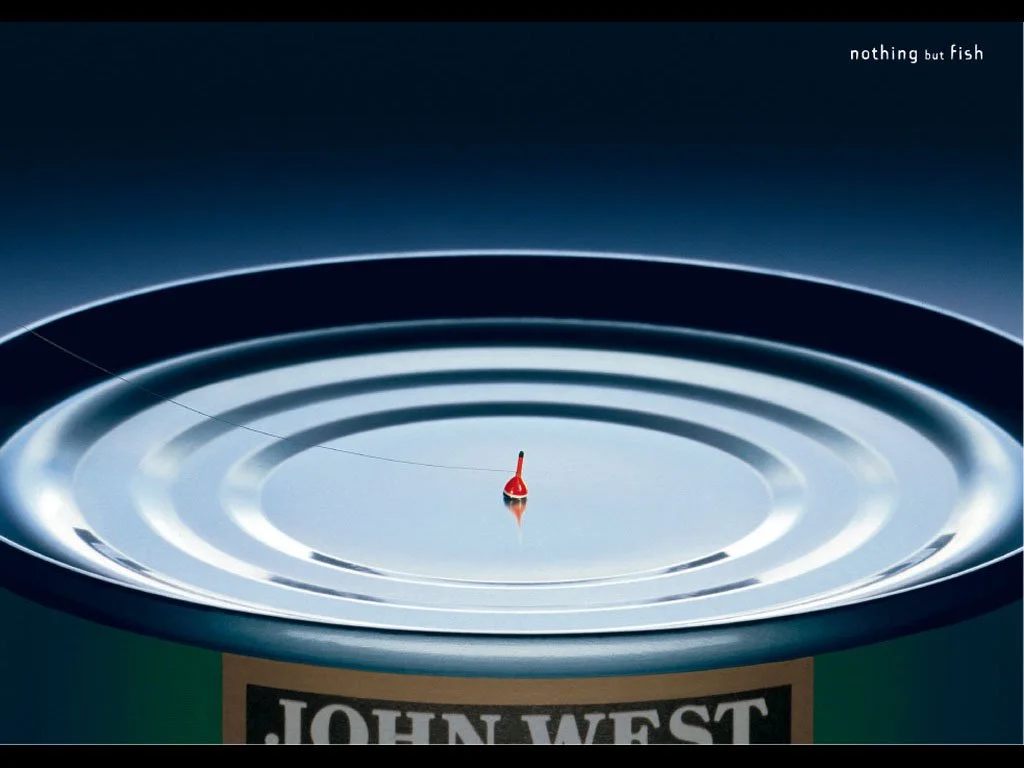
One of the first ADS THAT REALLY CAUGHT ME AND I remember really stopping to look at was this John West AD.
I came across it in the Duncan of Jordanstone library sometime in the early noughties, when I was at university. We were lucky to have a brilliant library there, packed with the kind of stuff that, as a young designer, felt like treasure: D&AD annuals, Grafik magazines, Baseline, the Art Directors Club and countless books filled with work from around the world.I loved all of it.But looking back, I think what I miss most isn't necessarily the books themselves. It's the ritual of it.You'd go into the library without necessarily knowing what you were looking for. You'd pull something off a shelf. Flick through it. See something interesting. Put it back. Pick up another one. You'd naturally gravitate towards things that caught your eye and, without really realising it, spend an hour or two just looking.There was no algorithm trying to work out what you might like.No endless feed.No constant stream of perfectly presented work competing for your attention.Just you, a book and the time to properly look.And then something like this would stop you.The idea is incredibly simple: the top of a John West tuna tin becomes the surface of the sea. Its concentric ridges transform into ripples, with a tiny red fishing float sitting almost perfectly in the middle.That's it.But it's such a beautifully economical idea.The physical characteristics of the product become the visual. The tin isn't simply photographed alongside an image of fish or the sea. The tin becomes the sea.And suddenly the product itself is doing the communicating.The little float adds another layer to the idea, subtly reinforcing the connection with fishing and, often, being interpreted as a reference to line-caught fish. The whole thing leads neatly back to the simple line: “Nothing but fish.”The work was created by Leo Burnett in London. The credits list Richard Connor as Art Director, Julie Adams as Copywriter, Nick Bell and Mark Tutssel as Creative Directors, and Andy Roberts as photographer.It's also a nice reminder that a great advertising idea doesn't necessarily need to shout.There's barely anything going on here.No elaborate composition. No complicated typography. No clever animation. No visual effects. No campaign toolkit with 47 different executions.Just an observation.A tin lid looks like ripples.And someone had the instinct to notice it, connect it to the product and turn it into an idea.That's probably why it stayed with me.It's also interesting to see that the ad is still being talked about today. The Drum recently included “Nothing But Fish” in a list of favourite outdoor ads, describing it as timeless and praising the simplicity of connecting something that was essentially staring you in the face.For me, though, its significance is probably less about the awards or the creative credits.It's about where I found it.I wasn't served it because I'd searched for “best print advertising”. I didn't see it because somebody had posted it on Instagram. I didn't save it to a Arena board. I didn't even know I was looking for it.I just happened to be flicking through a book.And I think there's something really valuable in that kind of discovery.We're surrounded by incredible work now. Probably more than at any other point in history. Every day we're exposed to identities, campaigns, motion, photography, typography, 3D, AI, websites, posters and endless visual references from every corner of the world.It's amazing.But it's also exhausting.When everything is designed to grab your attention, perhaps one of the most valuable things we can give ourselves as designers is the opportunity to slow down and deliberately look.To wander a little.To be bored.To pick up something without knowing why.To spend ten minutes looking at one page.To let an idea find you rather than constantly searching for the next thing.Because sometimes, tucked away in a book in a university library, you find a tiny fishing float sitting in the middle of a tin of tuna.And twenty years later, you still remember it.